
Maine FOAA and Cumberland County Public Records
Maine's open-records law is the Freedom of Access Act, often called FOAA. It starts from a simple rule. Public proceedings and public records are open to inspection unless a statute or court rule makes them confidential. That presumption of access is the legal backbone for almost every Cumberland County public records request.
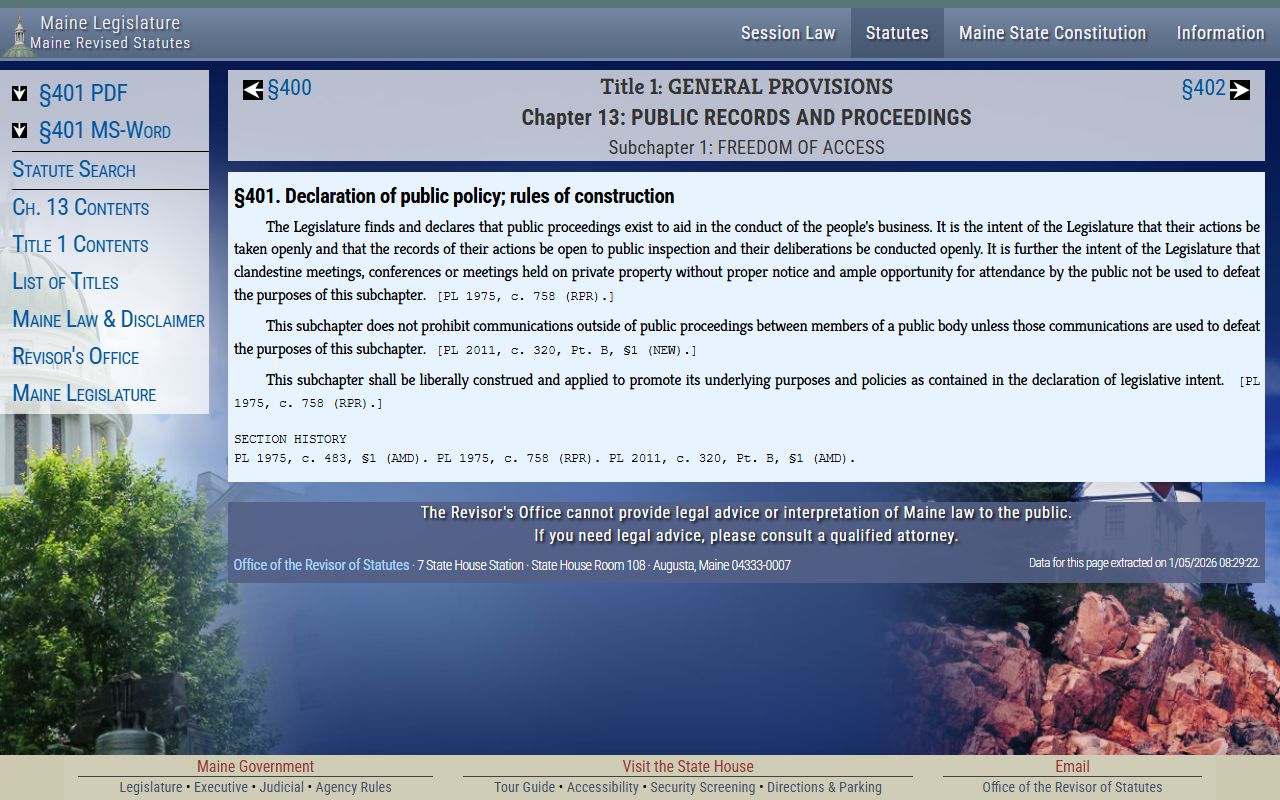
The law spells out its own purpose. The public policy section declares that government records stay open so people can know what their government is doing. The statement of public policy is shown in the Maine FOAA public policy screenshot below.
FOAA also defines what counts as a public record and who must answer a request. A public record is generally any record a public agency or official keeps that relates to public business, unless the law carves it out. Almost anyone can ask, and a requester does not need to explain why. The definitions live in 1 M.R.S. § 402, which sets the boundary between open records and the confidential categories the law excludes.
What Cumberland County Public Records Cover
Court files are only one slice of the county's records. Cumberland County keeps several major record sets across separate offices, and each has its own custodian and request path. Land records sit with the Registry of Deeds, estate files with the Probate Court, and police paperwork with the Sheriff. Picking the right office first is the key step.
- Land and property records, including deeds and plans, held by the Registry of Deeds.
- Probate filings, such as wills, estates, guardianships, and conservatorships, held by the Probate Court.
- Sheriff incident and crash reports, handled by the Sheriff's Records Department under FOAA.
- County administrative records of board, budget, and department business.
State court case files are different. They follow Maine Judicial Branch rules and the eCourts access framework, not the FOAA agency process in the same way, which is why a docket search runs through the courts rather than a county FOAA request.
Court Records Versus Agency Records
FOAA governs public agencies and officials, but court records carry an extra layer. They also answer to Judicial Branch rules, administrative orders, case-confidentiality statutes, and any sealing order tied to a specific case. The first thing to settle is the custodian. A state court file goes through the Judicial Branch clerk or Service Center, while a county agency record goes through that agency under FOAA.
This split matters in practice. A criminal history summary comes from the Maine State Police, not from a county FOAA request, and it is governed by a separate part of state law. A driver record comes from the Bureau of Motor Vehicles. Matching the record to the right office and the right rule saves time and avoids a denial built on the wrong request. For court files, the Cumberland County court records page walks through the judicial search tools.
The custodian list is worth memorizing. The Judicial Branch clerk or Service Center holds state court files. The Probate Court and its Register hold estate and protective records. The Sheriff's Records Department holds incident and crash reports. The Registry of Deeds holds land records. Each one answers a request on its own terms, so a single broad letter to the county rarely reaches all of them at once.
How to File a Public Records Request in Cumberland County
A FOAA request can be short, but it should be clear and in writing. Address it to the office that holds the record, describe what you want with enough detail to find it, and give a way to reach you. A focused request moves faster and costs less than a broad one.
- Identify the office that keeps the record, such as the Registry of Deeds for land, the Probate Court for estates, or the Sheriff's Records Department for incident and crash reports.
- Describe the records you want, with names, dates, or a case or report number when you have them.
- Submit the request in writing through the channel that office accepts, such as mail, in person, or email.
- Wait for the agency to acknowledge the request and give a good-faith time estimate.
- Pay any allowed fees, then inspect the records or receive the copies.
Note: Sheriff incident and crash reports are requested through the Records Department by mail, in person, phone, or email, while court files go through the Judicial Branch instead.
Public Records Request Fields
Most offices, whether they use a form or accept a letter, look for the same basic details. The clearer the request, the easier it is for staff to locate the record and quote a fee. The table shows the fields that matter most.
| Field | Required | Notes |
|---|---|---|
| Requester Name | Yes | So the office can confirm the request and send a response. |
| Description of Records | Yes | Be specific, with names, addresses, or report numbers if known. |
| Date Range | No | Narrowing dates speeds the search and lowers cost. |
| Contact and Format Preference | No | Phone or email, and whether you want paper, electronic, or in-person review. |
Response Timelines Under FOAA
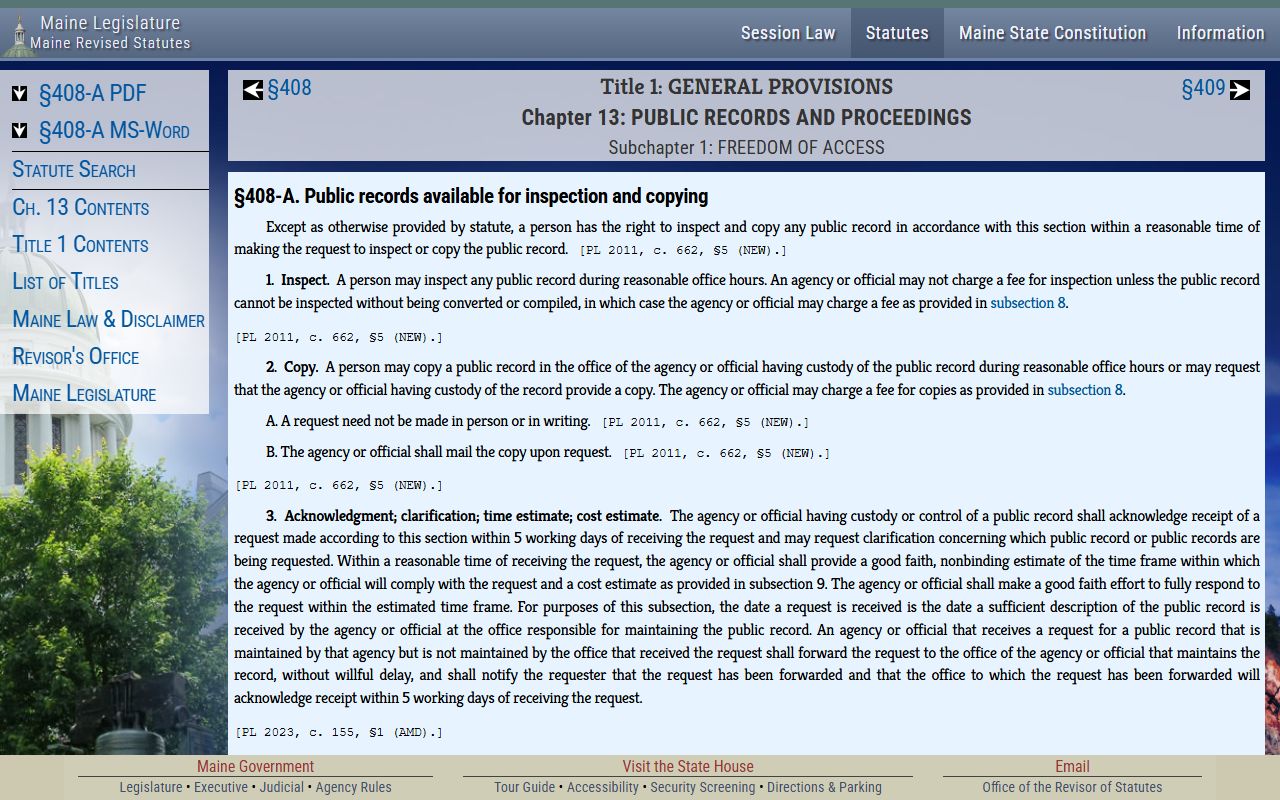
FOAA sets out how an agency must handle a request from start to finish. The inspection and copying section requires an agency to acknowledge a request within a set window, give a reasonable estimate of the time and cost to produce the records, and then provide them within a reasonable period. It is the practical engine of the law.
That processing section is shown in the FOAA inspection and copying screenshot below.
An agency can take time to gather, review, and redact records, but it cannot ignore a request or stall without reason. If a record is partly confidential, the office should release the open parts and explain what it withheld.
Cumberland County Public Records Fees
Fees depend on which office holds the record. FOAA allows agencies to charge for copies and, within limits, for the staff time to search and review. County offices publish their own schedules on top of that framework. The table lists common examples from Cumberland County offices.
| Item | Amount |
|---|---|
| Sheriff report, 1-7 pages | $12 |
| Sheriff report, each additional page | $1 |
| Sheriff report, each photo | $2 |
| Sheriff non-paper request | $25 |
| Probate filing copy | $2 per page |
FOAA addresses these charges in 1 M.R.S. § 408-B, which is read alongside each agency's specific copy fees. Court copies follow the Judicial Branch schedule, and probate copies follow the Probate Court schedule.
Land Records and the Registry of Deeds
Land records are among the most requested public records in any county, and Cumberland County has one of Maine's deepest sets. The Registry of Deeds records legal documents that affect real estate, with land records reaching back to 1753 and plan records to 1828. These files support property research, title work, and genealogy alike.
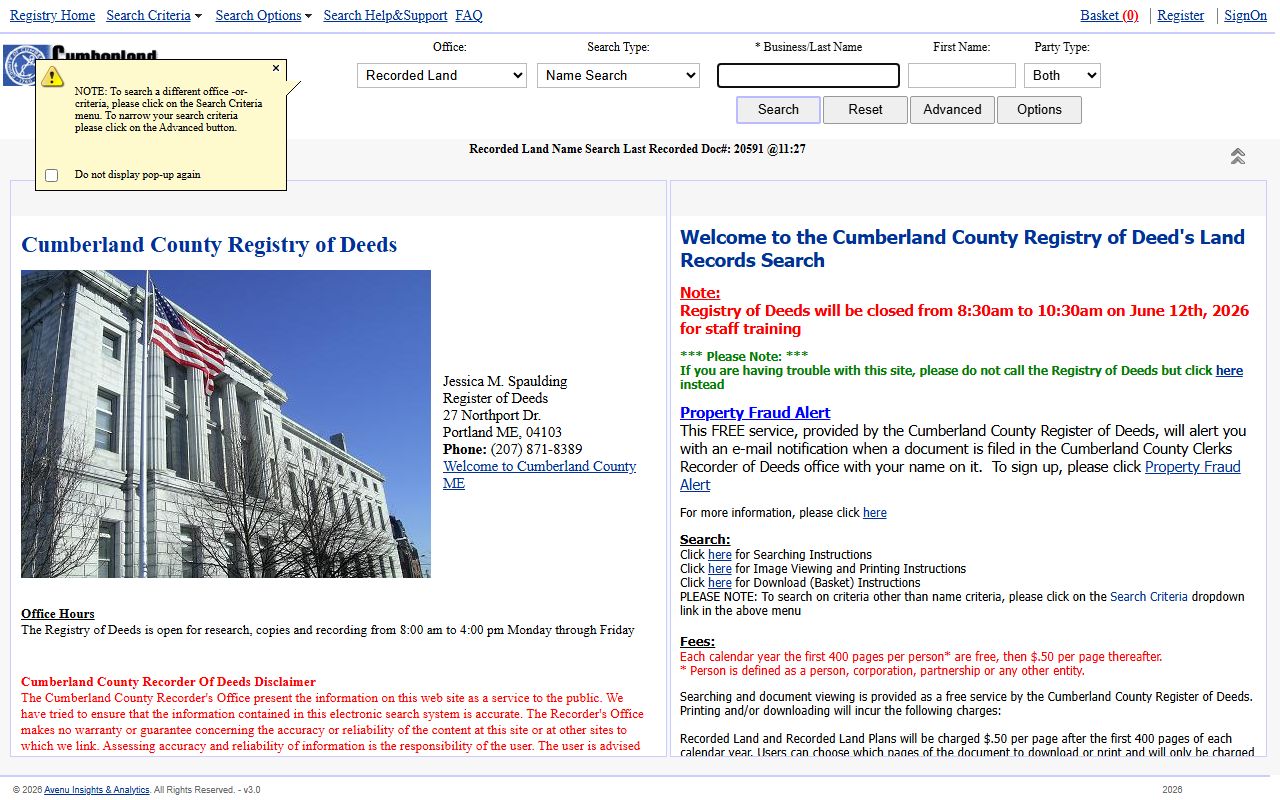
Many deed records can be searched online. The county's land-records portal lets the public look up recorded documents from a browser, shown in the Cumberland County deed search screenshot below.
For details on register staff, hours, and current recording fees, the Cumberland County Registry of Deeds page is the official source. A 2026 fee change adjusted recording and plan charges, so confirm the current rate before recording a document.
Records That Are Exempt
FOAA opens the door, but many records stay closed by other laws. Confidential categories are excluded from the definition of a public record, so they are not released through an ordinary request. The exemptions protect privacy, safety, and the integrity of sensitive proceedings.
Common closed categories in Cumberland County include juvenile records, adoption records dated after August 8, 1953, child protection and protection-order files with restricted access, sealed criminal records, and adult guardianship and conservatorship file documents limited since January 2026. Medical information held by the jail is withheld under federal health privacy law. When a record is partly exempt, the office should release the open portion and identify what it held back.
If Your Request Is Denied
A denial is not the end of the road. FOAA gives requesters a way to challenge a refusal. The law provides an appeal and enforcement route, so a person who believes a record was wrongly withheld can seek review and, if needed, a court order to release it.
That remedy lives in 1 M.R.S. § 409-A, the public-records appeal and enforcement section. Before going that far, it often helps to ask the office to explain the legal basis for the denial in writing, since a narrower or clearer request sometimes resolves the problem without a formal appeal.