
How to Look Up Cumberland County Jail Population Data
Population figures live in published reports, not a live dashboard. The Sheriff's Office posts annual reports in its document center, and those reports are the authoritative local source for counts at the Cumberland County Jail. The page lists a current 2025 report alongside historical reports running back to 2010. These are yearly documents, so the cadence is annual rather than daily, which makes them ideal for trends but not for a same-day headcount.
National and state context fills the gaps the local reports leave. The federal Bureau of Justice Statistics publishes jail population data by state, and the Prison Policy Initiative builds Maine profiles from that data. Read the local numbers as county figures, and treat state or national rates as separate benchmarks. The annual reports are the place to confirm any exact county count.
The Sheriff's annual report center holds the current and historical reports, shown in the Cumberland County Sheriff annual reports screenshot below.
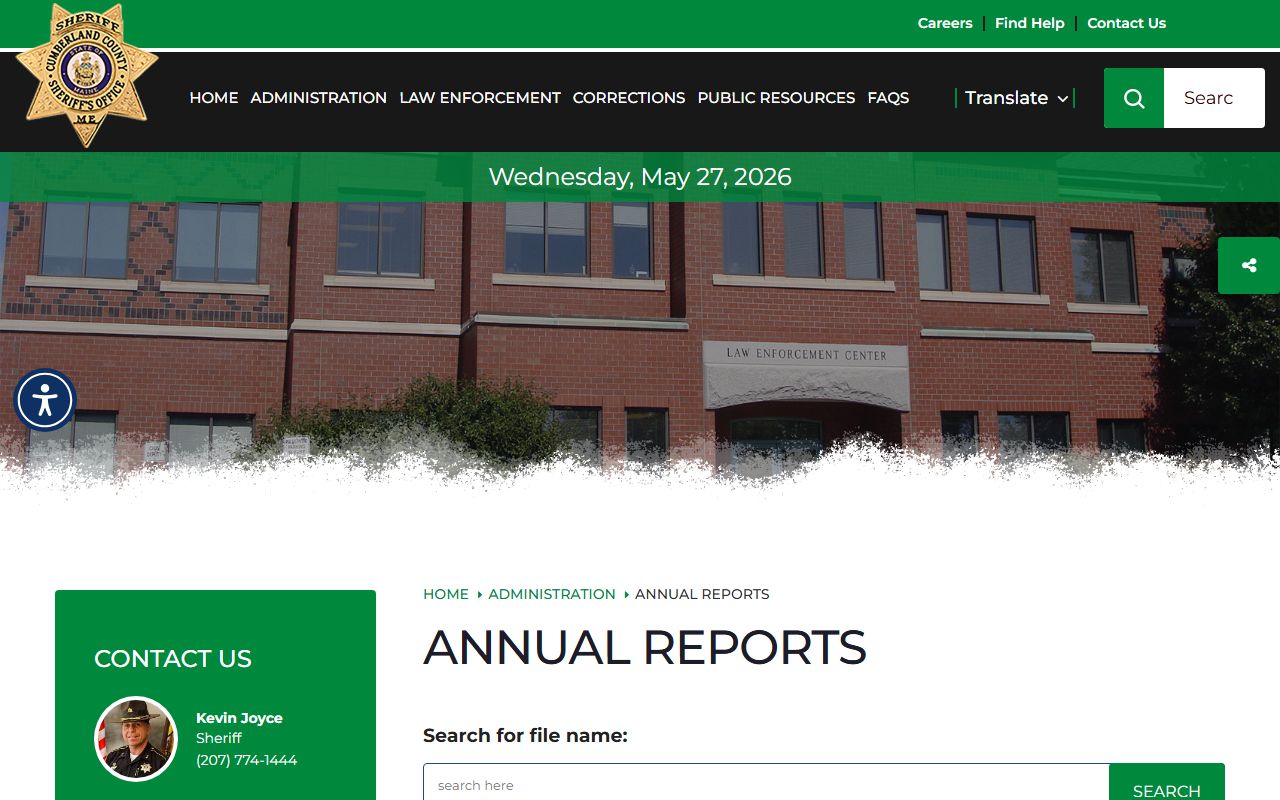
Open the most recent annual report first, then compare it against earlier years to see how the population has moved.
Cumberland County Jail Capacity Overview
The Cumberland County campus on County Way is built around custody and corrections work. The Sheriff describes the jail as the largest in Maine and as a state-of-the-art incarceration facility. The Sheriff's FAQ also references a Community Corrections Center as part of the County Way campus structure. A rated bed count is not published in the official page text reviewed for this profile, so the capacity figures below are marked as not stated rather than estimated.
| Facility | Role | Rated Capacity |
|---|---|---|
| Cumberland County Jail | Primary detention, largest jail in Maine | Not stated in official page text |
| Community Corrections Center | Referenced as part of the County Way campus | Not stated in official page text |
| Sheriff's Office | Law enforcement and administration | Not a detention facility |
For a confirmed bed count, the Sheriff's annual reports are the right source, since they carry the operational figures the public pages summarize. The 2025 report is the best starting point. The Sheriff's Office counts about 260 members across law enforcement and corrections, which signals the scale of the operation even where a bed number is not posted.
Cumberland County Average Daily Population
Average daily population, or ADP, is the headline number for any jail. It measures the typical count held on a given day across a year, which smooths out the daily swings from bookings and releases. Cumberland County does not post a current ADP figure on its public corrections pages. The annual reports are the document type that usually carries ADP and booking totals, so the most recent report is the right place to read the exact county figure.
ADP matters because it drives staffing, medical demand, and budget. A jail that calls itself the largest in Maine will run a higher ADP than a small county lockup, even before any rate comparison. Read the figure as a county number tied to a specific year, and check the year label before comparing two reports.
Cumberland County Inmate Demographics
Jail demographics describe who is held, usually by gender, race, and age. Cumberland County does not publish a standing demographic table on its public corrections pages, so exact county percentages are not reproduced here to avoid inventing them. The annual reports are the local document that can carry these splits, and federal data offers a benchmark for the categories a report typically tracks. The categories below are the ones worth looking for, with the source for each.
- Gender split, found in the Sheriff annual reports for the county figure.
- Race and ethnicity, in the annual reports, with BJS for state and national benchmarks.
- Age distribution, in the annual reports for the county count.
- State and national rates, from the Bureau of Justice Statistics and the Prison Policy Initiative.
Treat any percentage from a national source as a benchmark, not a county figure, until the county report confirms the local split. Mixing a national rate with a county headcount produces a number that means nothing, so keep the two apart.
Cumberland County Pretrial vs Sentenced
A county jail holds two broad groups. Pretrial detainees are held while their cases move through court, often because bail was set and not posted, sometimes after a warrant arrest. Sentenced inmates are serving a term after conviction. The split matters because pretrial holds reflect bail decisions, which the jail does not make, while sentenced counts reflect court outcomes. The table below explains each status and where the local figure is sourced.
| Status | What It Means |
|---|---|
| Pretrial | Held while a case is open, often on unposted bail set by a commissioner or court. |
| Sentenced | Serving a term after a conviction in District or Superior Court. |
| County source | Sheriff annual reports for the local pretrial and sentenced counts. |
| Benchmark source | Prison Policy Initiative for the share of jail holds that are pretrial nationally. |
The Prison Policy Initiative tracks how pretrial detention drives jail populations nationwide, shown in the Prison Policy Initiative screenshot below.

Its Maine profile is a useful benchmark, but the county pretrial share itself belongs to the Sheriff's annual report.
Cumberland County Charge-Level Population
Charge level shapes who stays longest. People held on felony charges tend to have higher bail and longer holds, while many misdemeanor cases resolve quickly. Maine sorts crimes into classes rather than a simple misdemeanor-felony line, with Class A, B, and C marking the more serious offenses. The county does not post a public charge-level breakdown of its jail count, so the annual report is again the right source for the local split.
The mix tilts the population in predictable ways. A jail with more serious holds carries a steadier count, since those people stay longer than short-stay misdemeanor bookings. For the charges behind any single person's stay, the inmate records page covers the live roster, and criminal records trace the underlying case.
Cumberland County Jail Health Population
Health needs are a large part of any modern jail population. The Cumberland County Jail runs a medical unit that offers 24-hour onsite physical, mental, and dental care through CFG Health. Intake screens each person's health on the way in and flags special needs, which is how the jail identifies people who need ongoing medical or mental health support. Prescriptions are verified through the pharmacy before they are given.
The county does not publish the exact share of inmates receiving mental health or medical care, so no percentage is stated here. What the official pages confirm is the scope of service: round-the-clock care across physical, mental, and dental needs, plus a re-entry program that coordinates medication-assisted treatment before release. Those services point to a population with real and continuing health demands.
Note: Federal HIPAA rules keep individual medical details private, so population health is described in aggregate terms rather than by named inmate.
State and National Population Context
County jail numbers make more sense next to state and national figures. The Bureau of Justice Statistics is the federal agency that measures jail populations across the country, and it reports incarceration as a rate per 100,000 residents so places of different sizes can be compared. Maine consistently ranks among the lower-incarceration states in these national datasets. To compare Cumberland County fairly, pull the county count from the Sheriff's report and the rate per 100,000 from BJS for Maine and the nation.
The table below maps each level to its authoritative source. Exact per-100,000 figures are not reproduced here, since the research did not extract a confirmed county rate and stating one without the source would risk inventing a number.
| Level | Best Source for the Rate |
|---|---|
| Cumberland County | Sheriff annual reports, paired with county population. |
| Maine | Bureau of Justice Statistics and Prison Policy Initiative. |
| National | Bureau of Justice Statistics jail population series. |
The Bureau of Justice Statistics is the source for state and national jail rates, shown in the Bureau of Justice Statistics screenshot below.

Use BJS for the per-100,000 benchmark, then read the Cumberland County count against it rather than mixing the two figures.
Cumberland County Population Trends
Trends need a run of years, and the Sheriff provides them. The annual report center lists reports for 2025, 2024, 2023, 2022, 2020, and a string of earlier years back to 2010. Reading several reports in sequence is the only sound way to see whether the Cumberland County jail population is rising, falling, or holding steady. A single year cannot show a trend on its own.
The reports also capture operational complexity that a raw count hides. The jail runs intake classification, medical screening, special-needs review, security evaluation, onsite health services, and re-entry programming, and it answers to a Board of Visitors. Those functions all scale with population, so the reports are worth reading in full rather than skimming for a single figure.
Searching for Cumberland County Inmate Records by Name
Population data answers how many, not who. For a name-based lookup of a specific person in custody, the live jail roster is the right tool, not these aggregate counts. The Cumberland County inmate records page covers that roster, its coverage rules, and how to read a booking record.
Where the Population Data Comes From
Three layers of sources back this page. The Cumberland County Sheriff's Office is the primary source for local counts, through its administration pages and annual reports. The Bureau of Justice Statistics supplies state and national jail figures, and the Prison Policy Initiative turns that federal data into Maine-specific profiles. Local numbers should come from the Sheriff, and rate comparisons from the federal sources.
The Sheriff's administration page carries the office history, staffing, and links to the report center, shown in the Cumberland County Sheriff administration screenshot below.
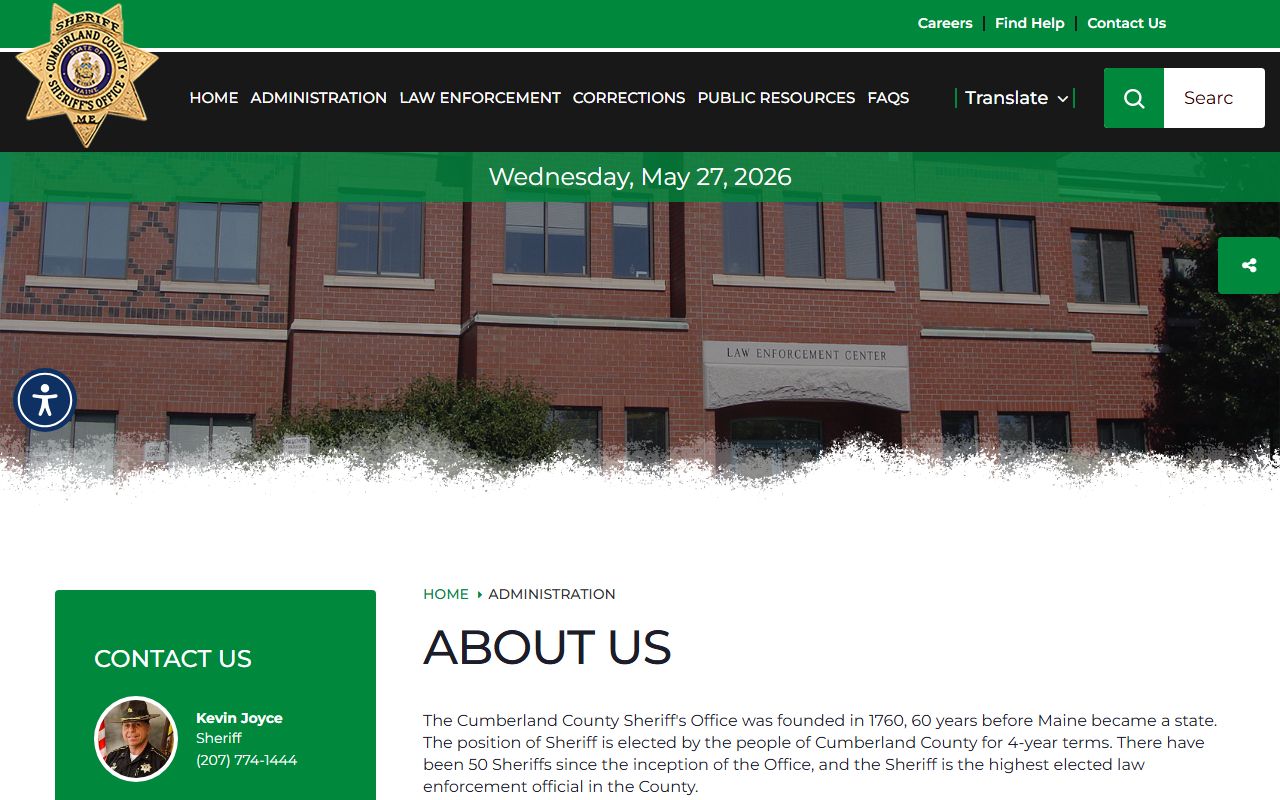
That page is the front door to the official county figures, while BJS and Prison Policy supply the wider context.