
Arrest Records in Cumberland County
An arrest record begins at booking. In Cumberland County, that record is created by the Sheriff's Office and by the local police departments that make arrests. The Cumberland County Sheriff's Office, led by Sheriff Kevin Joyce, runs the largest jail in Maine. When deputies or officers take someone into custody, intake staff book the person, screen them, and log the charge. That booking entry, not a court file, is the first arrest record.
An arrest record is not proof of guilt. It shows that police had reason to take someone in on a stated charge. The court file that follows is a separate thing, and it is built by the Maine Judicial Branch once charges are filed. Conviction comes later still, only if a plea or verdict settles the case. For the full court case history behind an arrest, the Cumberland County court records page covers how to pull dockets and dispositions. This page stays focused on the arrest and booking side.
The Sheriff's Office releases arrest and incident reports under Maine's Freedom of Access Act. Its Records Department handles those requests. The District 2 District Attorney, Jacqueline Sartoris, then prosecutes most criminal cases that grow out of those arrests.
How to Search Cumberland County Arrest Records
There is no single button for every Cumberland County arrest. The fastest path depends on what you need. To see who is in custody right now, use the public inmate locator run by the Sheriff. To get a paper arrest or incident report, file a request with the Sheriff's Records Department. For a statewide criminal history summary, go to the Maine State Police. The Sheriff's records request page explains report types, fees, and timelines, and it appears in the Cumberland County Sheriff records request screenshot below.
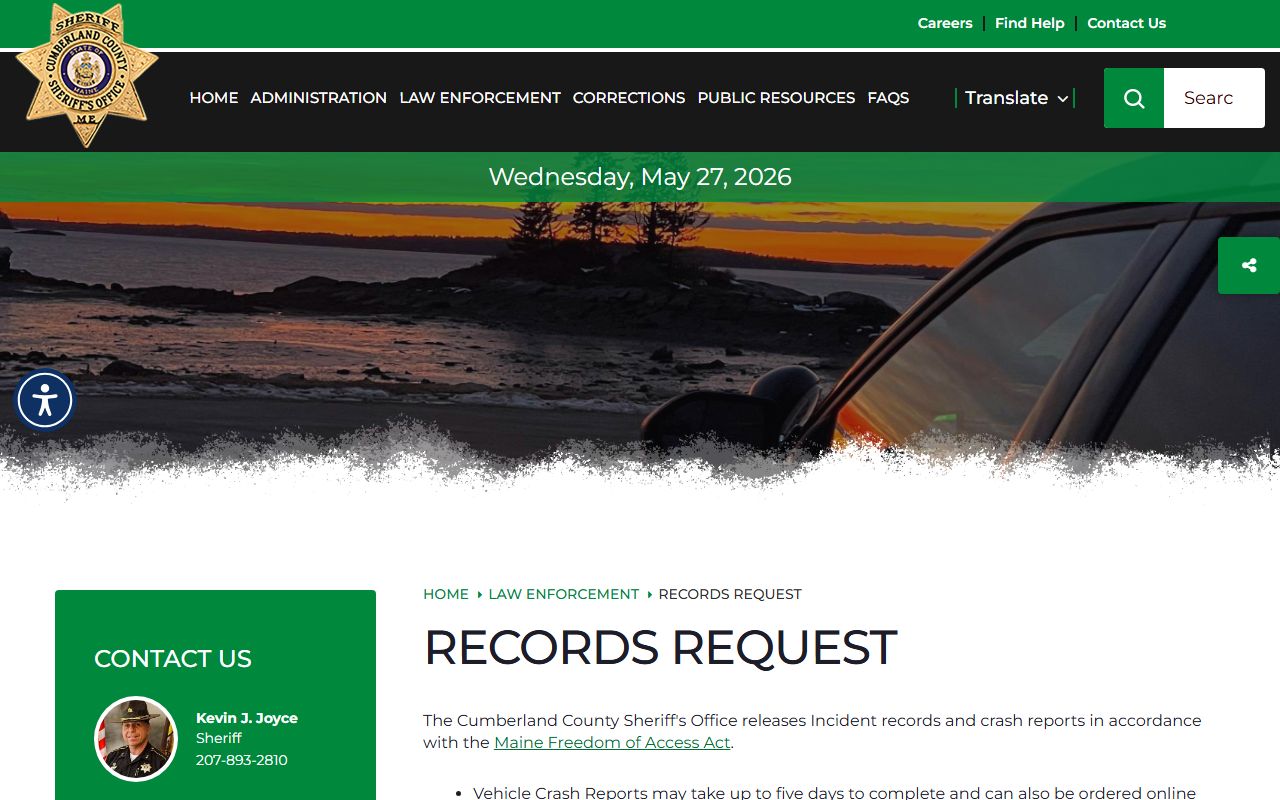
That page lists set timelines, such as up to five days for a deputy incident report and longer windows for crash or reconstruction reports. Use these steps to track a recent arrest in the county.
- Open the Sheriff's public inmate locator to check whether the person is still booked at the jail.
- Note the charge, booking date, and any hold listed in the result.
- Request a written arrest or incident report from the Sheriff's Records Department if you need the full report.
- For court status after the arrest, search the case through the Maine Judicial Branch tools described on the court records page.
The locator lists people currently held at the Cumberland County Jail and leaves out federal inmates. Names drop off once a person is released, so a missing name can simply mean the person already left custody. The list updates several times a day.
Arrest Records vs. Criminal Court Records
People often blend these two records into one, but they come from different offices and start at different times. An arrest record is law-enforcement paperwork created at booking. A criminal court record is built by the Maine Judicial Branch once a prosecutor files charges. One can exist without the other. Police may make an arrest that never leads to a charge, and a court case can be filed by summons with no booking at all.
| Arrest Record | Criminal Court Record | |
|---|---|---|
| Source | Sheriff or local police | Maine Judicial Branch court clerk |
| Created When | At booking | When charges are filed |
| Contents | Booking data, charge, mugshot, hold | Docket, pleadings, motions, disposition |
| How to Reach It | Sheriff Records Department or inmate locator | re:SearchMaine or a mailed OTH-009 request |
For the court side, the court records page walks through re:SearchMaine and the OTH-009 search form. Use the arrest record for booking facts and the court record for what happened after.
Charges vs. Convictions
A charge is an accusation. A conviction is a finding or admission of guilt. The gap between them matters a great deal when reading any Cumberland County arrest record. At arrest, police only need probable cause, a reasonable belief that a crime occurred. A conviction takes far more. The state must prove the case beyond a reasonable doubt, or the person must enter a guilty plea. Many charges are reduced, dismissed, or resolved through the District Attorney's diversion track.
| Charge | Conviction | |
|---|---|---|
| Stage | Accusation at or after arrest | Verdict or guilty plea |
| Burden of Proof | Probable cause | Beyond a reasonable doubt |
| Where It Shows | Arrest record and early docket | Court disposition |
| Public Record | Yes, if not sealed | Yes, if not sealed |
Note: An arrest or a charge alone does not mean a person was convicted, so always confirm the final disposition through the court before drawing a conclusion.
Sealed vs. Expunged Records
Maine handles adult criminal relief through sealing, not automatic expungement. This is an important distinction. Sealing restricts public access to a record once a court orders it. It does not erase the record from every government system. Courts, law enforcement, prosecutors, and certain background-check entities may still reach a sealed record in situations the statute allows. Public website copy should use the word sealing for Maine adult records unless an official source clearly uses expungement.
| Sealed (Maine adult records) | Expunged | |
|---|---|---|
| What Happens | Public access is restricted by court order | Record is destroyed or treated as if it never existed |
| Law Enforcement | May still access in allowed cases | Very limited access |
| Maine Use | Primary adult relief, set by statute | Not the standard adult path in Maine |
| Eligibility | Depends on offense class, waiting period, and record | Narrow and statute-specific |
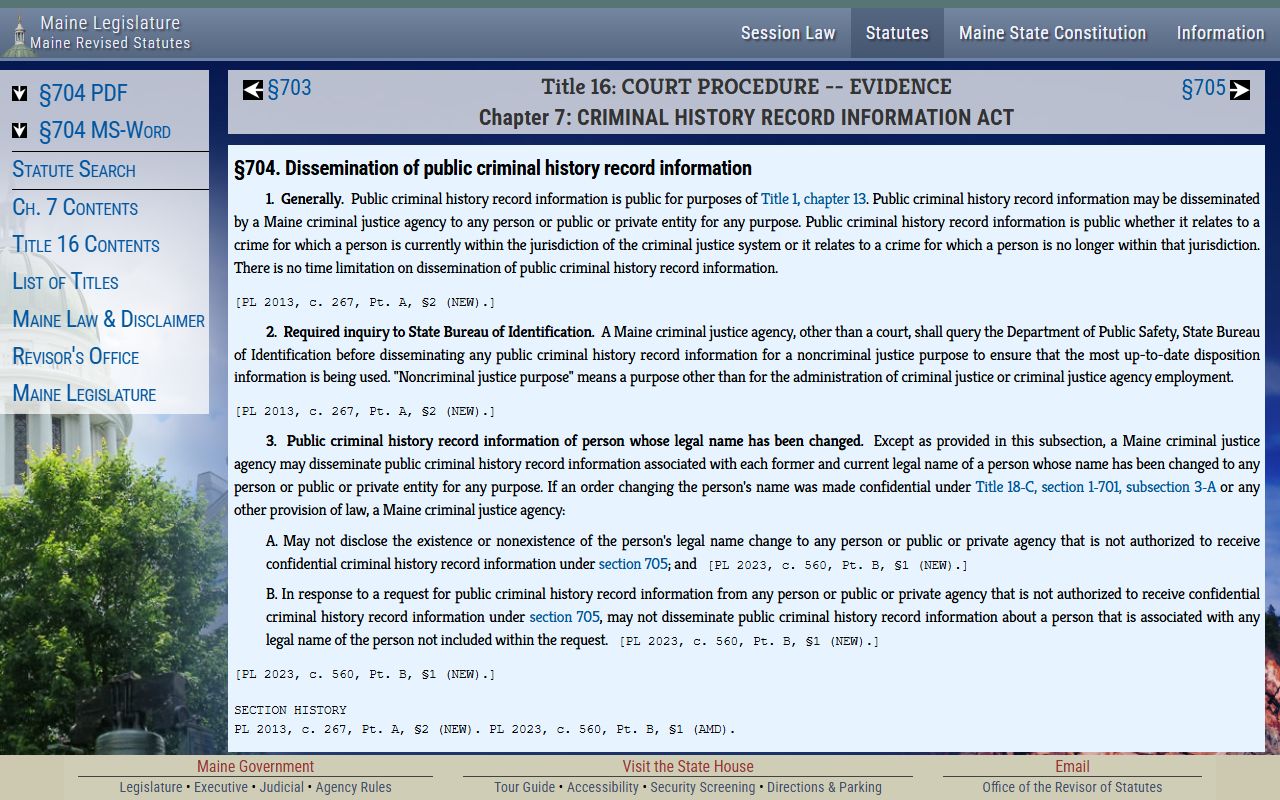
Eligibility for sealing turns on the offense class, the time since final disposition, the person's broader record, and any disqualifying events. The criminal history dissemination rules sit in 16 M.R.S. section 704, which controls who may receive criminal history information. The practical starting point for sealing is the court that handled the case or the Judicial Branch forms and rules.
Mugshots and Booking Photos
A mugshot is the booking photo taken at intake. In Cumberland County, booking photos are part of the Sheriff's records, not the court file. The Sheriff's Records Department handles report requests under Maine FOAA, and its fee schedule charges extra for photos within a report. A booking photo shows the person at one moment in time and says nothing about guilt.
Be careful with private mugshot sites. They are not official, they often charge removal fees, and they may post stale or wrong data. The reliable source is the county itself. For who is held now, the Sheriff's inmate locator is the official tool, and the inmate records page explains how to read a booking profile.
Statewide Criminal Records Search
A county arrest record is local. A statewide criminal history summary is broader, and it comes from the Maine State Police State Bureau of Identification. The Bureau is the state agency that maintains and shares Maine criminal history record information. Its summary pulls data from law enforcement, prosecutors, courts, and correctional facilities. That is different from a single Cumberland County booking entry or one court docket.
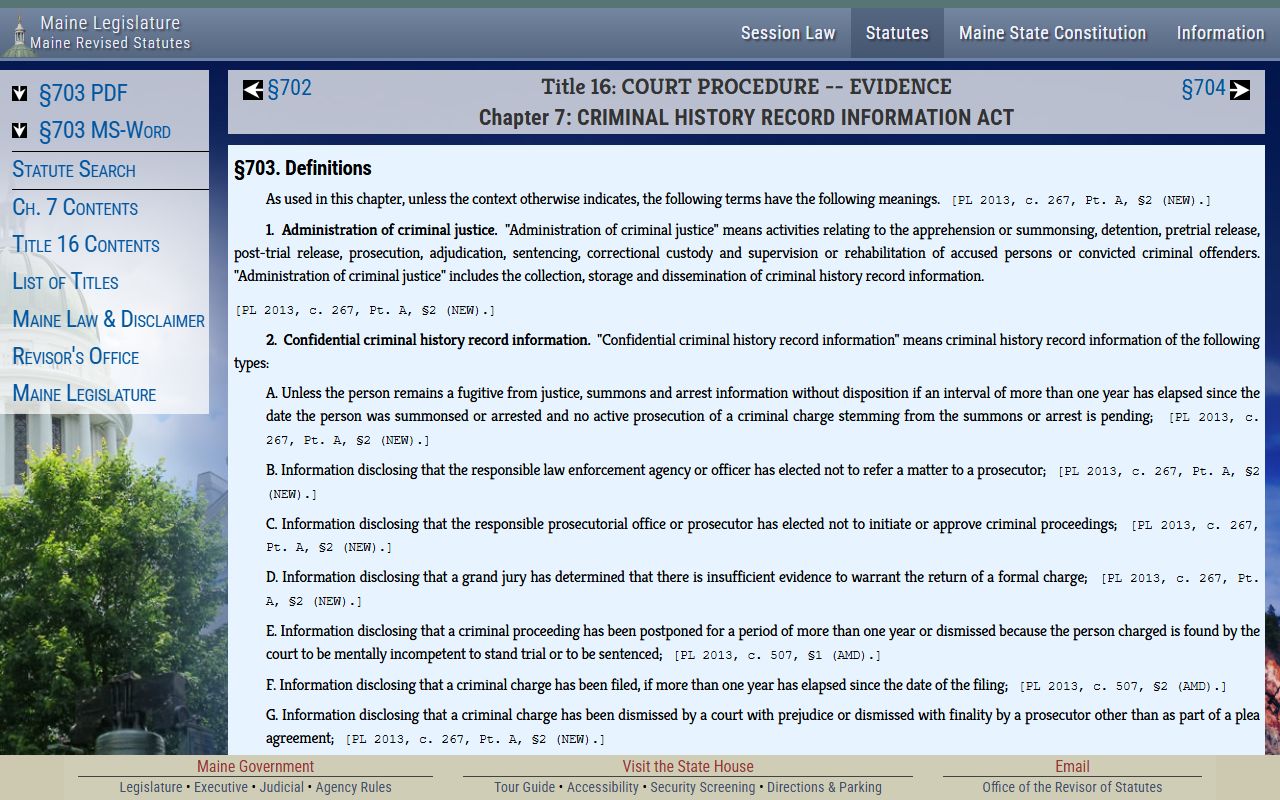
Maine law defines this information in 16 M.R.S. section 703, which sets out what counts as criminal history record information. The State Police FAQ cites that definition, and it is shown in the Maine criminal history definitions screenshot below.
The Bureau offers two kinds of checks. A name-based check finds possible matches by name and date of birth. A fingerprint-based check is the only way to confirm an exact match. The rules that control who may receive that summary live in the dissemination statute, shown in the criminal history dissemination screenshot below.
The Maine Department of Corrections runs a separate tool. Its adult resident and community corrections search shows people under DOC custody or supervision, and that page is shown in the Maine DOC corrections search screenshot below.
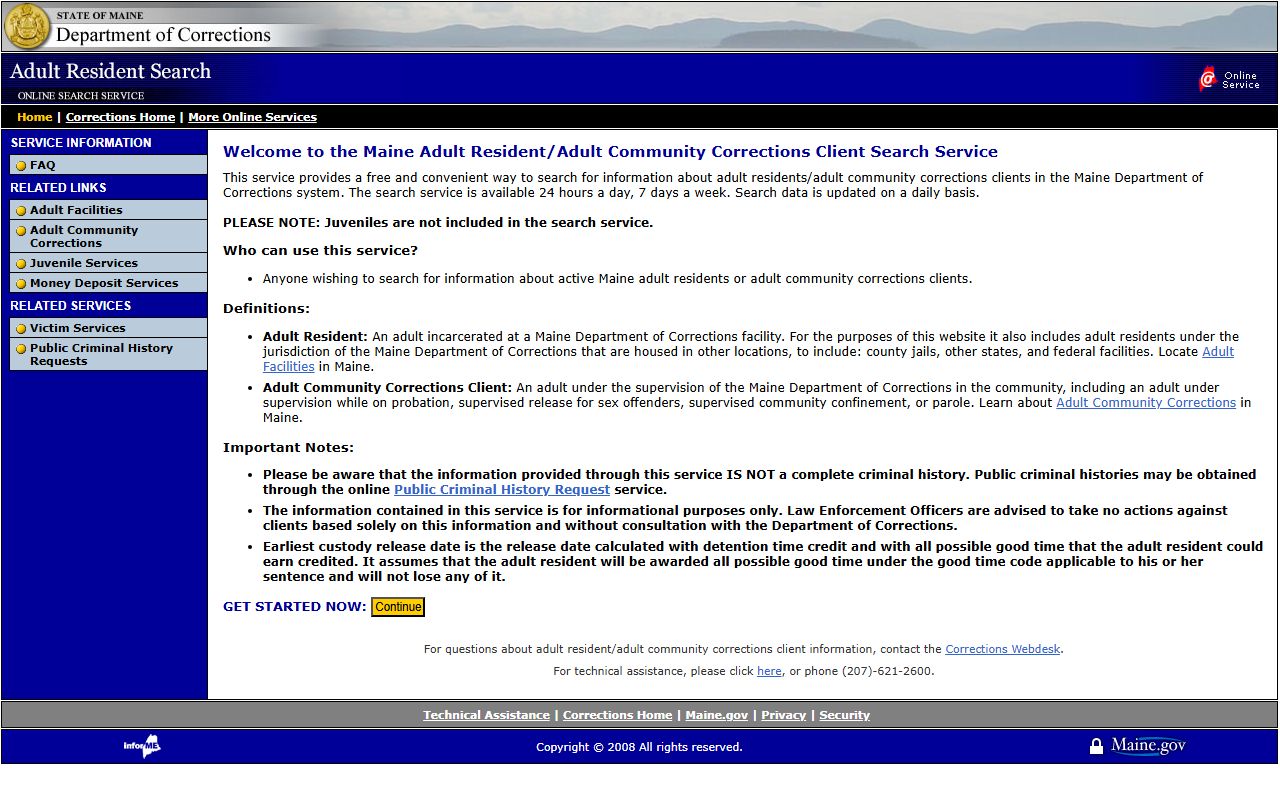
The DOC search is free, updated daily, and runs around the clock. It is not a complete criminal history, and it leaves out juveniles entirely. For a full statewide summary, the Public Criminal History Request service is the right route.
The Maine Sex Offender Registry
Some arrest and conviction records connect to the state registry. The Maine State Police maintain the Maine Sex Offender Registry, the official statewide source. Sheriff's offices or private sites may post other offender data, but the State Police registry is the authority. A search there is free, and a registrant is not told when a member of the public looks up their name.
The registry can also show whether a registrant is currently incarcerated. Its FAQ explains the search levels, the responsible agency, and how notifications work, and it is shown in the Maine Sex Offender Registry FAQ screenshot below.
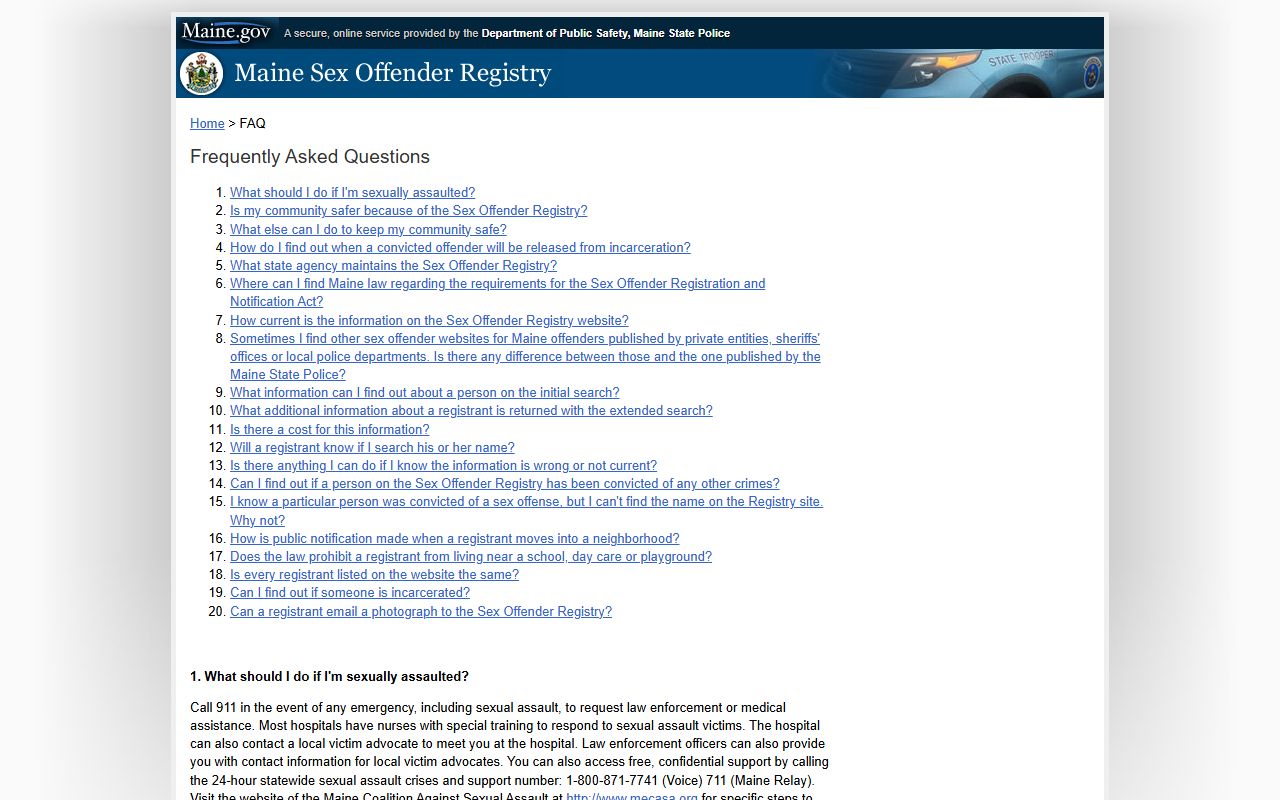
An initial search and an extended search return different levels of detail. The registry is built under the Maine Sex Offender Registration and Notification Act.
The District Attorney and County Courts
After an arrest, the case moves to the District Attorney. Cumberland County is its own prosecutorial district, District 2, led by District Attorney Jacqueline Sartoris. The office prosecutes nearly all criminal cases in the county, except murders, which the Maine Attorney General handles. The office runs about 51 staff and roughly 10,000 cases a year, which reflects the county's size.
Most criminal cases are filed in the Portland Unified Court, formerly the Portland Superior Court. The DA also holds office hours at the West Bath Courthouse and Bridgton District Court. Court locations and contact details appear in the District Attorney court locations screenshot below.
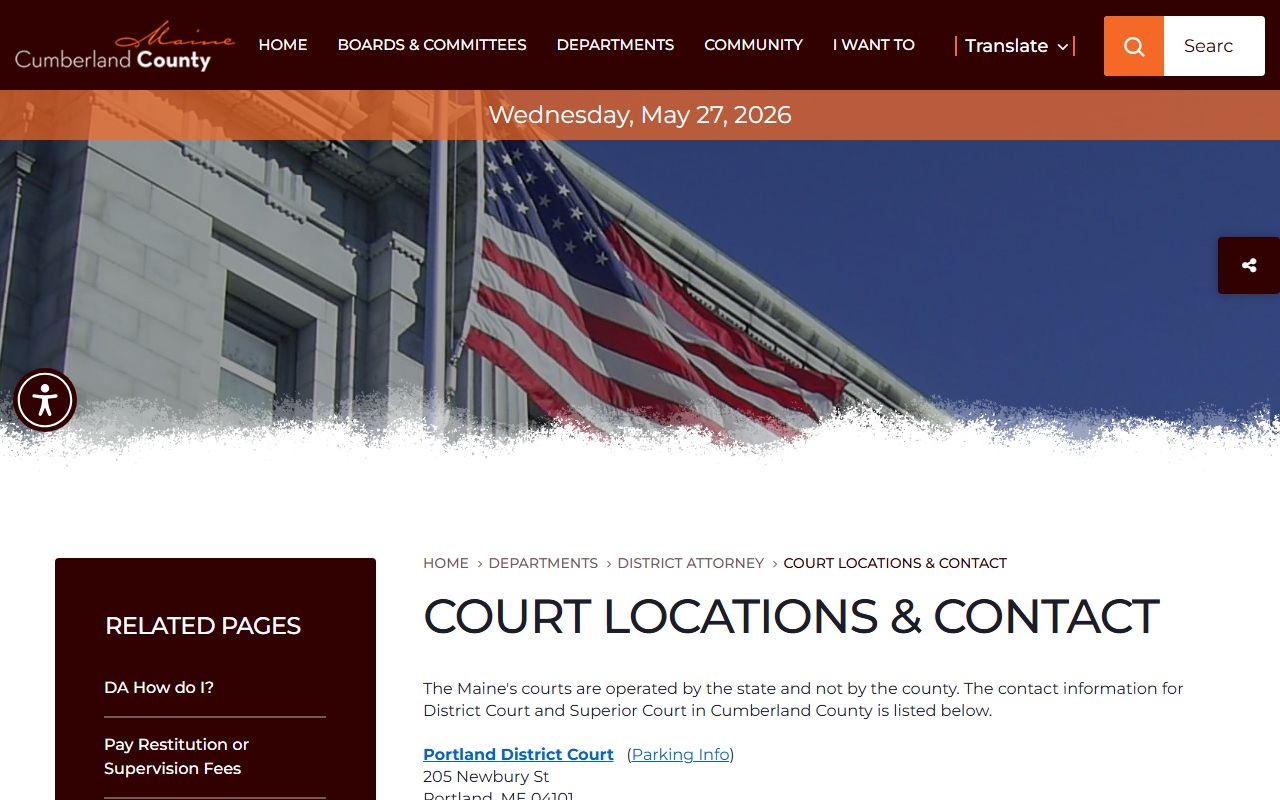
The office runs a Diversion and Rehabilitation track and assigns specialized domestic violence prosecutors. Diversion can change what eventually shows in a court record. For the full case file behind an arrest, including charges, motions, and disposition, the court records page is the next stop, and DUI or OUI matters that overlap with driving are covered on the traffic court records page.
Background Check Considerations
Casual lookups and formal background checks are not the same. Checking a name on the inmate locator or pulling a county report is a quick, informal step. A formal background check used for hiring, housing, or credit is regulated by the federal Fair Credit Reporting Act. Those checks must run through a consumer reporting agency that follows strict rules. A name-based result can also bring back the wrong person, since names and birth dates are not unique.
Important: This website is not a consumer reporting agency under the Fair Credit Reporting Act, and its information cannot be used for employment, housing, credit, or other regulated screening.
Restricted Criminal Records in Cumberland County
Not every arrest or criminal record is open. Maine law closes several categories. Juvenile records are restricted under 15 M.R.S. section 3308, and the Maine DOC adult search leaves juveniles out. Juvenile crime information may be shared only in narrow cases, generally for conduct that would be murder or a Class A, B, or C crime if an adult did it. Sealed criminal history stays out of public results once a court orders the sealing.
Other limits apply to active work. Some warrants and sealed indictments are not public before they are executed. Medical information collected at the jail is withheld under federal health privacy law. When a record is unclear or seems incomplete, the office that holds it, the Sheriff for arrest reports or the court for the case file, can explain what is and is not releasable. For warrant questions tied to an arrest, see the warrant records page.